Real estate conversations in Gurgaon tend to collapse into two camps: those who believe everything is overpriced, and those who believe everything is still a deal. Both camps are wrong. The honest answer is that pricing varies dramatically by cluster, asset class, and transaction type — and some pockets of the market remain genuinely rational while others have moved well ahead of fundamentals.
This analysis uses our benchmark data covering 10 Gurgaon clusters across residential, commercial, and plotted segments. We're looking at Q1 2025 pricing.
How we're defining "fairly priced"
A property is fairly priced when the asking price per sqft sits between the P25 and median for its cluster and asset class. Below P25 suggests either a deal or an undisclosed problem. Above P75 means you're paying a premium that needs to be justified by something specific — location within the cluster, floor, view, or developer.
We're using SBA (super built-up area) pricing throughout for consistency. If you're comparing carpet-basis numbers, apply a loading factor of 1.25–1.4 depending on the project.
Where pricing is still rational
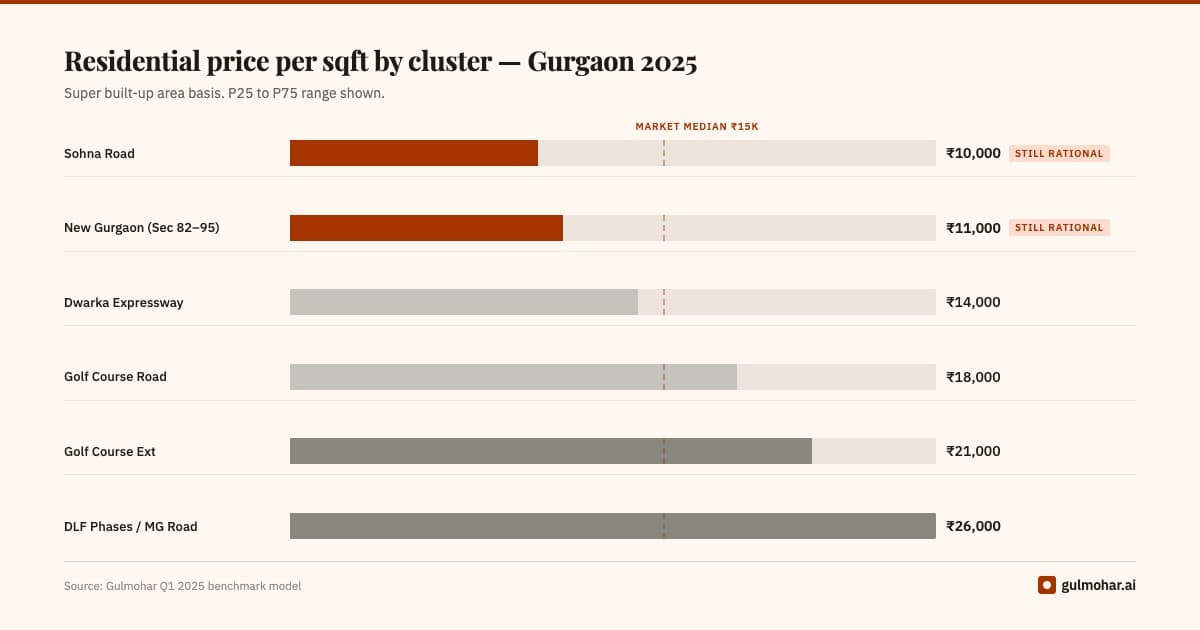
New Gurgaon (Sectors 82–95) remains the most value-dense residential pocket in the city for buyers who can tolerate a 6–10km commute from Cyber City. Median residential PPSF sits around ₹11,000 on SBA basis — roughly half of Golf Course Ext's ₹21,000 median at a fraction of the infrastructure risk, since much of the sector development here is new.
The catch: UC supply is high at around 58%, which caps near-term liquidity. This is not a flip market. If you're buying for end-use with a 5+ year horizon, the fundamentals hold.
Sohna Road at ₹10,000 median is the market's most patient play. Appreciation has been slow and the commute friction is real. But for buyers who work in South Gurgaon or are genuinely flexible on location, the entry point relative to quality of development is hard to argue with.
If you're evaluating a property in either of these clusters, run it through the Gulmohar engine to see how it benchmarks specifically against comparable listings — the cluster median is a starting point, not the full picture.
Where you are paying for the story
Golf Course Ext has appreciated sharply since 2022. Median PPSF now sits at ₹21,000 on SBA, with P25 at ₹17,000 and P75 at ₹26,000. The fundamentals are real — infrastructure density, proximity to commercial hubs, resale liquidity. But a significant portion of current pricing reflects anticipated metro connectivity and general luxury brand value rather than present-day yield.
If you're buying at ₹24,000+ PPSF in GCE, your return thesis needs to be appreciation, not yield. Gross yields in this cluster are running at approximately 5.1% on current pricing — serviceable, but not the 7–8% that many buyers assume.
DLF Phases / MG Road is a similar story at a higher price point. Median at ₹26,000, P75 at ₹36,000. The resale liquidity is arguably the best in Gurgaon. But you're buying the brand and the address as much as the asset.
The under-construction discount is narrowing
Historically, under-construction properties traded at a 15–20% discount to ready-to-move inventory to compensate for delivery risk and the cost of carry. That discount has compressed significantly in 2024–25.
In several clusters, UC pricing is now within 8–10% of RTM. That's not enough of a discount to justify the execution risk, the loan disbursement complexity, or the opportunity cost of capital tied up during construction — the honest UC vs RTM math lays out exactly what that carry cost looks like. Unless you have a specific reason to buy UC — a particular project, floor preference, or payment plan advantage — the RTM premium is increasingly worth paying.
The Dwarka Expressway corridor
One cluster that doesn't fit neatly into either camp: Dwarka Expressway (Sectors 102–113). Median residential PPSF sits at ₹14,000–₹16,000, up from ₹9,000–₹10,000 in 2020. The infrastructure case is real — the expressway itself, the upcoming metro extension on the Dwarka Sector 21 corridor, and proximity to IGI Airport. But the appreciation has been front-loaded, and buyers entering now are doing so at a different risk-reward point than those who bought in 2019–21.
The UC supply concentration here is among the highest in the city — over 62% of active listings are under-construction. That's not automatically a reason to avoid, but it changes the resale calculus. When your 2028 RTM possession comes to market, the competition from similar inventory is significant.
For end-users who need the airport proximity or the specific commute profile, this corridor makes sense. For pure investors, the entry price now requires more precision — a well-located project at ₹14,000 PPSF with strong developer credentials is a different thesis from a generic one at ₹16,500.
How to read a specific transaction
Cluster benchmarks give you the frame. They don't tell you whether a specific apartment is fairly priced. Here's what to check:
Carpet vs SBA loading: The spread between carpet area and super built-up area varies significantly by project — from a 1.20x loading factor to 1.45x or higher. Two apartments quoted at ₹18,000 PPSF can have effectively different carpet-basis costs of ₹21,600 and ₹26,100 respectively. Always convert to carpet basis before comparing.
Floor premium: In most Gurgaon projects, each floor adds 0.5–1% to the base price. A 25th-floor unit listed at the same PPSF as a 5th-floor unit in the same project is not comparably priced.
Launch-era pricing: Projects launched in 2020–21 that haven't transferred ownership yet often have resale listings at significant premiums to the original launch price. That premium is the previous buyer's profit — and it may not be justified by the current market level for comparable RTM inventory.
Transaction vs listing price: Listed prices in Gurgaon run 7–12% above typical transaction prices for most clusters. A property listed at ₹22,000 PPSF in GCE that transacts at ₹19,500–₹20,000 is not an anomaly — it's the market. Your negotiation benchmark should be the transaction-level P25, not the listing median.
Registry value and agreement value frequently diverge in Gurgaon. Stamp duty is paid on whichever is higher — the registered circle rate or the agreement value. For any property where the seller proposes registering at a value materially below the agreement amount, understand the legal and tax exposure before proceeding.
What to do with this
Every one of these cluster-level observations needs to be tested against your specific property. A well-specified 3BHK at ₹22,000 PPSF in GCE might be a better deal than a poorly configured apartment at ₹18,000. The benchmarks give you the frame. The evaluation gives you the verdict.
Run your property through the Gulmohar engine.
Get a full deal assessment, financial fit score, and shock simulation — not a generic verdict.
EVALUATE A PROPERTY →Benchmark data sourced from Gulmohar's Q1 2025 model covering RERA registrations, active listings, and transaction data. Figures are indicative and should be verified against specific project pricing.