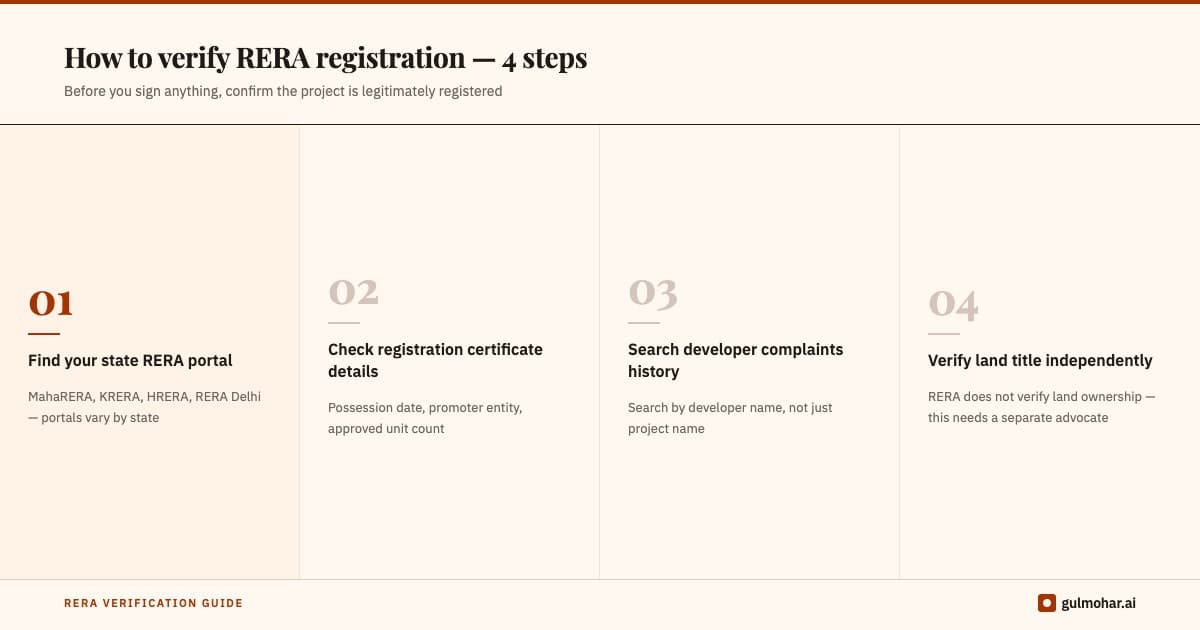
RERA was introduced to bring accountability to a market that had systematically failed buyers. The registration requirement matters — but it is a floor, not a guarantee. A project can be RERA-registered and still be severely delayed, poorly funded, or in litigation. What you're looking for is the combination of registration status plus the detail that registration surfaces.
Step 1: Find the correct state RERA portal
Every state has its own RERA authority and its own portal. The quality of data varies significantly — MahaRERA is among the most detailed; some smaller states have portals with limited search functionality. Key portals for major markets:
- Maharashtra: MahaRERA — maharera.mahaonline.gov.in
- Karnataka: KRERA — rera.karnataka.gov.in
- Haryana: HRERA — hrera.org.in
- Delhi: DRERA — rera.delhi.gov.in
- Telangana: TGRERA — rera.telangana.gov.in
- Uttar Pradesh: UP RERA — up-rera.in
- Tamil Nadu: TNRERA — tnrera.in
The developer or broker should provide the RERA registration number unprompted. If they don't, ask for it directly. If they are slow to provide it, treat that as a signal — registered projects have nothing to hide.
Step 2: What to check on the RERA certificate
Once you have the registration number and can pull the project page, look for:
Possession date: Compare the registered completion date with what the developer is telling you verbally. Discrepancies of 6–12 months between the two are common. A developer who files an optimistic completion date with RERA and then tells buyers a more realistic timeline is not committing a crime — but it tells you how they treat their legal filings.
Promoter details: Check that the legal entity named as promoter matches the entity you will be signing an agreement with. Group companies, SPVs, and subsidiary entities are common — the promoter registration should be consistent throughout your transaction documents. If the RERA certificate names "XYZ Developers Pvt Ltd" but the booking form is from "XYZ Realty LLP," ask for an explanation in writing.
Approved unit count: The number of units registered must match or exceed what the developer is selling. Developers selling inventory beyond what is registered is a direct RERA violation.
Financial data (where available): MahaRERA and a few other portals now publish financial disclosures including the proportion of project costs to be funded by collections from buyers versus external financing. A project that is 90% buyer-funded with minimal developer equity is more exposed to a slowdown in sales than one with diversified funding.
Quarterly progress reports: MahaRERA and several other portals require developers to file quarterly construction progress reports. Pull the last 3–4 filings. Consistent delays in filing, or filings that show static progress across quarters, are warning signs. If the report for Q3 shows the same percentage completion as Q2 and Q1, construction is not moving at the rate the developer is claiming.
RERA registration does not guarantee project completion. It means the project has met the administrative requirements to be registered. Projects have been delayed and abandoned after registration. The registration certificate is the start of your due diligence, not the end.
Step 3: Check for complaints and legal action
Most RERA portals have a complaints section. Search the developer name — not just the project name — for any filed complaints.
A single complaint from a single buyer is noise. Every developer with a large project will have at least one. What you are looking for is pattern:
- Multiple complaints about delayed possession from the same project
- Complaints about refund disputes — suggesting buyers who walked away after concluding the project was troubled
- Complaints that have been escalated to adjudicating officers, indicating the developer did not comply with initial RERA orders
Separately, search the developer name on the National Company Law Tribunal (NCLT) website for any insolvency proceedings. RERA registration offers no protection if the developer subsequently enters insolvency. Some of India's largest developers have had NCLT proceedings against them for specific project entities — this check costs you ten minutes and is non-negotiable for any mid-size or newer developer.
Step 4: Verify the land title independently
This is where most buyers stop short. RERA registration does not involve a title check. The authority registers the project; it does not certify that the developer has clear, unencumbered title to the land on which the project is being built.
Title verification requires a separate legal opinion from an advocate who has reviewed the original title documents — not a summary from the developer's in-house legal team. The full title check process covers what documents to ask for and what a clean title opinion looks like.
At minimum, ask for the title search report and get your own advocate to confirm:
- The land is free of encumbrances and has no registered charges or mortgages
- There are no pending litigations on the plot in any court
- The developer holds the correct development rights, whether through ownership or a development agreement with the landowner
- The Joint Development Agreement (if applicable) grants the developer valid authority to sell units
Run your property through the Gulmohar engine.
Get a full deal assessment, financial fit score, and shock simulation — not a generic verdict.
EVALUATE A PROPERTY →What RERA status tells you — and what it doesn't
It's useful to be precise about what you learn from a RERA check:
| What RERA tells you | What RERA does not tell you | |---|---| | The project is registered and legally permitted to be sold | Whether the project will be delivered on time | | The registered completion date | Whether the developer has the funds to complete | | The approved unit count | Whether the land title is clear | | Filed complaints against the developer | Whether the construction quality is adequate | | Quarterly progress reports (on better portals) | Whether the developer's other projects are in trouble |
The distinction matters because buyers sometimes treat a clean RERA check as a green light. It isn't — it's a necessary condition, not a sufficient one.
The Gulmohar risk score
Our risk assessment includes RERA registration status, developer tier (based on delivery track record across multiple projects), and legal flag indicators as inputs in the deal score. A project with RERA registration from a developer with a consistent delivery record scores materially differently from a project with registration but a history of delays and complaints — even at the same price point.
Portal URLs and verification processes are accurate as of early 2026. Specific portal features vary by state and are updated periodically by RERA authorities.